Phase 3 asks: does the same thermal-exposure → extirpation signal still emerge when the curated continental dataset is replaced with open GBIF occurrence records for the Iberian Peninsula?
This is a Replicability check in FORRT vocabulary — same code (the validated Python port from Phase 2), different conditions (regional zoom to a southern-Europe subregion, different occurrence data source).
Why Iberia
Many Bombus species reach their southern range limit on the Iberian Peninsula. If Soroye’s mechanism is real — that the frequency of historically extreme temperatures, not mean warming, drives extirpation — then Iberia is exactly where one would expect a stronger signal than the continental mean. The Phase 3 result either supports that prediction or it doesn’t.
What was changed
| Element | Phase 2 | Phase 3 |
|---|---|---|
| Occurrence data | Soroye’s bundled continental dataset | Open GBIF Bombus for ES + PT, GBIF.org User (2026) (36 560 records, 2026-04-25) |
| Climate | CRU TS 3.24.01 monthly | Same |
| Pipeline | weatherxbiodiversity Python port | Same (only 01_clean_data_iberia.py differs from 01_clean_data.py) |
| Grid, periods, model spec | unchanged from Phase 2 | unchanged |
Headline result
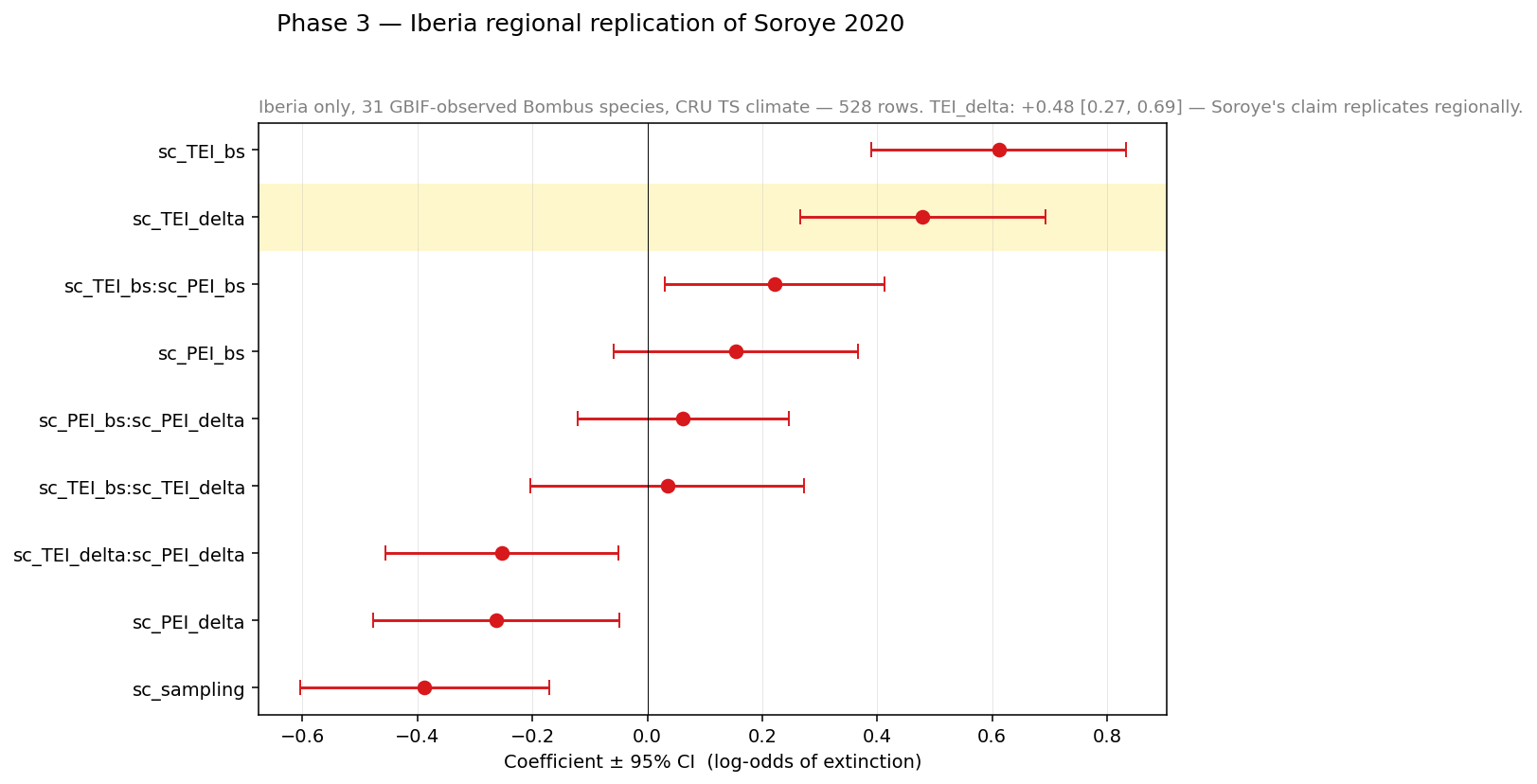
sc_TEI_delta = +0.4792, 95 % CI [0.266, 0.693]   (mixed-effects, VB)
sc_TEI_delta = +0.2943, p = 0.007                (plain logit)
n = 528 species × cell observations across 31 Bombus species, 99 sampled cells
The claim replicates regionally and with a stronger effect than the
continental mean. The Iberian coefficient is approximately 3× larger in
magnitude than Phase 2’s +0.15 continental average.
Notable differences from Phase 2:
sc_TEI_deltais larger (+0.48 vs +0.15).sc_TEI_bsis also larger (+0.61 vs +0.21) — Iberia is concentrated near the warm end of Bombus thermal envelopes.The hot-edge × thermal-change interaction (
sc_TEI_bs:sc_TEI_delta) is positive but not significant on the smaller Iberian sample. This is most likely a sample-size / range-restriction effect rather than a real difference in the underlying mechanism.
The nanopubs
Replication Study
Show the Phase 3 Replication Study nanopub inline
View Phase 3 Study on Science Live →
Replication Outcome — Validated, High confidence
Show the Phase 3 Replication Outcome nanopub inline
View Phase 3 Outcome on Science Live →
CiTO link to Soroye 2020
View Phase 3 CiTO on Science Live →
Caveats
Iberian sample size is small (528 species × cell observations) so credible intervals on individual coefficients are wider than on the continental Phase 2 dataset. The point estimate (+0.48) should be interpreted with this in mind.
Variational Bayes posterior may underestimate credible-interval width by approximately 10–20 % relative to full MCMC.
GBIF Iberian Bombus coverage before approximately 1920 is sparse, which reduces the temporal span of the effective baseline window relative to Soroye’s continental dataset.
What this enables
With Iberian replication confirmed, the same validated pipeline becomes a tool — projecting onto future climate, identifying refugia, applying the mechanism to other thermally-sensitive insect taxa. See Discussion for what’s next.
- GBIF.org User. (2026). Occurrence Download. The Global Biodiversity Information Facility. 10.15468/DL.3FRMSQ