The Global Extent and Determinants of Savanna and Forest as Alternative Biome States — replication study.
Reference paper: Staver et al. (2011)
Staver, Archibald & Levin (2011) found that at intermediate rainfall (1000–2500 mm) tree cover is bimodal and only fire separates savanna from forest. This repository revisits that claim at a regional scale: the Beni savanna–forest mosaic of Bolivia, one of the ecosystems the paper’s argument is about.
Question. Within comparable rainfall, does the share of land that burned in 2024 fall as pre-fire above-ground biomass rises?
Data. Three open products are put on one grid — HEALPix depth 11 on the WGS84 ellipsoid (about 3 km cells) via healpix-connector:
ESA CCI Biomass v7.0: above-ground biomass for 2023, the year before the fires.
ESA Fire_cci SYN v1.1: burned area for 2024.
CHELSA bio12: mean annual precipitation.
Headline result (10,344 cells):
| Pre-fire biomass (Mg/ha) | <10 | 10–25 | 25–50 | 50–100 | 100–150 | ≥150 |
|---|---|---|---|---|---|---|
| Mean share burned in 2024 | 32.1% | 27.3% | 19.7% | 13.6% | 5.6% | 1.4% |
Burned share falls with biomass overall (Spearman ρ = −0.38).
It also falls within each rainfall tercile (ρ = −0.23, −0.24, −0.39), so rainfall alone does not explain the pattern.
99% of cells lie inside the paper’s 1000–2500 mm band.
Biomass is strongly skewed (bimodality coefficient 0.72), which is consistent with, but not proof of, two alternative states.
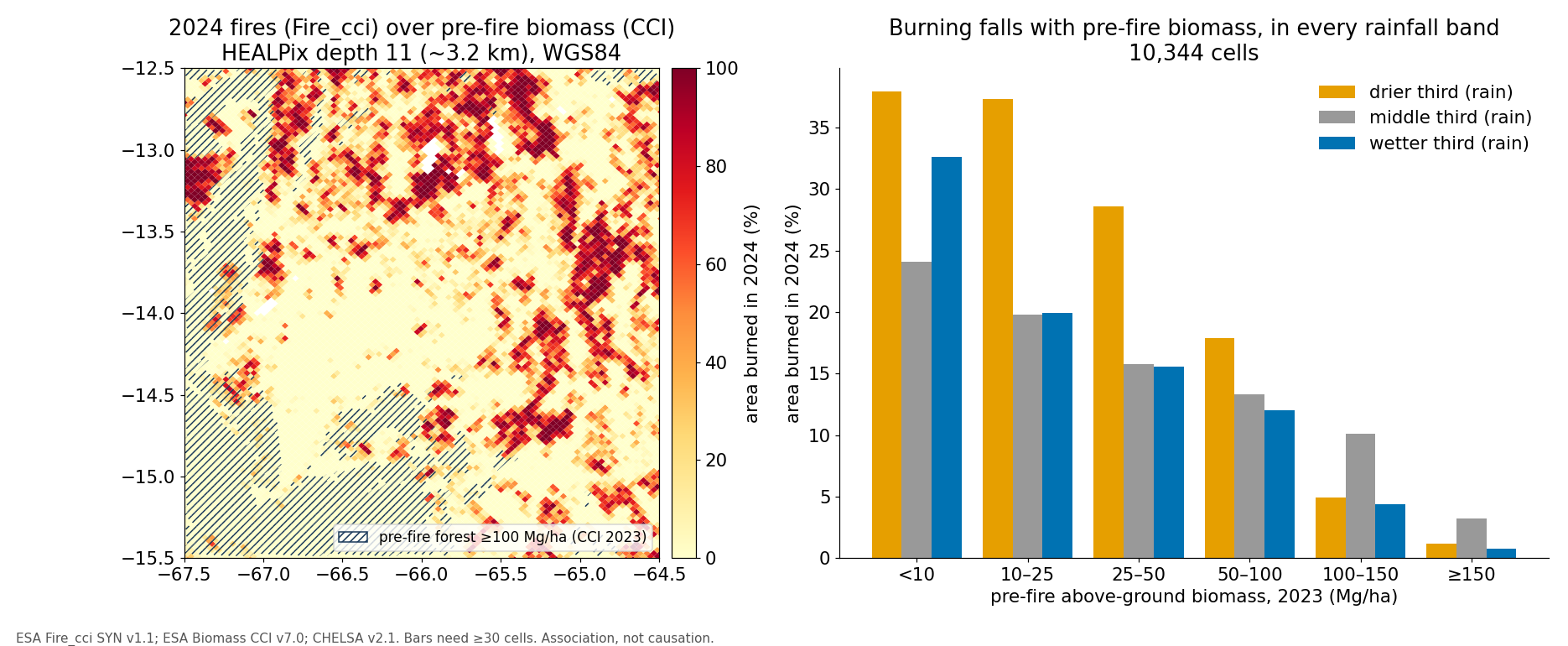
Verdict: partially supported. This is one region and one fire year, and the result is an association. It cannot tell “fire keeps biomass low” apart from “low-biomass land burns more”, so it supports the fire–biomass link the paper describes but does not test the mechanism. The full reasoning is in the FORRT nanopublication chain.
It produces:
A reproducible computational pipeline (Snakefile + notebooks).
A FORRT-tagged nanopublication chain on the Science Live platform, documenting the claim, the replication design, and the outcome with full provenance.
A Zenodo-archived release (source + container image) with a citable DOI.
Quick start
git clone https://github.com/annefou/beni-fire-biomass-healpix.git
cd beni-fire-biomass-healpix
pixi install
pixi run snakemake --cores 1
Or with Docker:
docker run --rm ghcr.io/annefou/beni-fire-biomass-healpix:latestStructure
paper/— the source paper PDF (drop yours in there).notebooks/— jupytext.pynotebooks that drive the pipeline.data/— raw inputs (~1.2 GB) are downloaded bynotebooks/01_data_download.pyand not committed; the per-cell tabledata/clean/beni_cells.parquetis committed so CI can re-run the analysis.nanopubs/— drafts of the FORRT chain field-by-field, plus the published-URI registry.docs/— operating manuals (FORRT form fields, chain decision tree, claim-type vocabulary).figures/— curated figures used in the Jupyter Book.
Nanopublication chain
The published chain is listed in nanopubs/PUBLISHED.md. Each step links to its viewer URL on the Science Live platform.
Citation
If you use this work, please cite both:
This software:
CITATION.cff→ DOI 10.5281 /zenodo .23002073. The original paper: Staver et al. (2011).
Research Object (ROHub): w3id
.org /ro -id /dd0e8130 -7e86 -4002 -8bb2 -b5e85f08e75e — one index of the code, release, notebooks, input datasets, paper and nanopubs.
- Staver, A. C., Archibald, S., & Levin, S. A. (2011). The Global Extent and Determinants of Savanna and Forest as Alternative Biome States. Science, 334(6053), 230–232. 10.1126/science.1210465
- Fouilloux, A., & LifeWatch ERIC. (2026). healpix-connector: connect existing data repositories to the HEALPix grid, with declared support, valid time and uncertainty. Zenodo. 10.5281/ZENODO.22904851