Iberian Bombus extirpation under DestinE Climate DT SSP3-7.0 — replication of Soroye et al. (2020). Reference paper: Soroye et al. (2020)
This repository is a self-contained replication of the headline claim of Soroye et al. (2020), “Climate change contributes to widespread declines among bumble bees across continents”, applied to Iberian Bombus with a future projection under DestinE Climate DT SSP3-7.0.
The replication has two tiers:
Tier 1 — historical fit. Replicates Soroye’s GLMM on Iberian Bombus using Soroye’s own CRU TS 3.24.01 climate inputs (Figshare deposit) and own-issued GBIF download DOIs. Run twice: once on the original CEA grid (~100 km), once on HEALPix nside=64 (~92 km).
Tier 2 — future projection. Applies the fitted GLMM to DestinE Climate DT SSP3-7.0 (IFS-NEMO standard, native HEALPix nside=128) for the 2020–2029 and 2030–2039 horizons. The only place new climate data enters.
HEALPix terminology (GRID4EARTH). This study uses HEALPix at
nside = 64. In the GRID4EARTH /healpix-geovocabulary that is depth 6 (nside = 2**depth). HEALPix bins are cells (each addressed by auint64ipixindex) in NESTED ordering, evaluated on the WGS84 ellipsoid via the authalic-sphere mapping — not a bare sphere. We keep thensidespelling in code for healpy-compatibility, but the equal-area guarantee comes from the ellipsoidal (ellipsoid="WGS84") path.
Headline result — Tier 1
![Tier-1 GLMM coefficient summary: sc_TEI_delta is positive, large, and credible at CEA (+0.479) and HEALPix nside=64 (+0.454, 95% HDI [+0.130, +0.751])](/weatherxbiodiversity-projection/build/main_result_healpix-ccea622047de27b1dd68f4276dc40f83.png)
Soroye’s central biological claim — that thermal-niche exceedance increases extirpation probability — replicates on Iberian Bombus at both spatial substrates. The GLMM coefficient on sc_TEI_delta is positive, large, and credible:
| Substrate | sc_TEI_delta β | Status |
|---|---|---|
| CEA (~100 km) | +0.479 | Replicated (Tier 1) |
| HEALPix nside=64 (~92 km) | +0.454, HDI [+0.130, +0.751] | Substrate-robust (Tier 1) |
A higher-resolution sibling study at HEALPix nside=128 (weatherxbiodiversity-projection-nside128) finds +0.347, HDI [+0.139, +0.533] — within ±30% of CEA, so the Tier-1 finding holds across three independent pixelisations.
Headline result — Tier 2
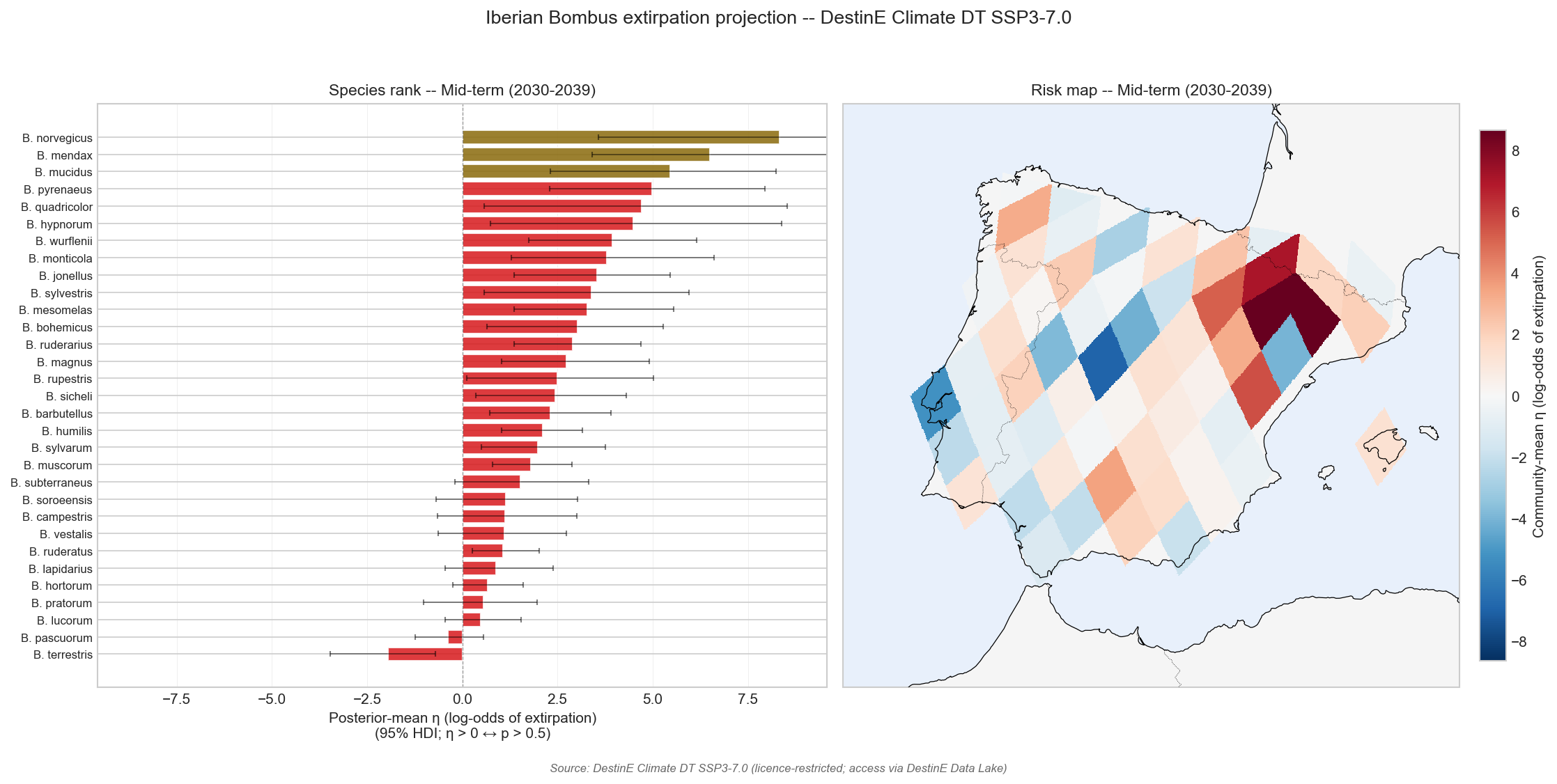
Under SSP3-7.0 at 2030–2039, mean future TEI rises from ~0.43 (historical) to ~0.45–0.50, a systematic shift toward each species’ upper thermal niche edge. None of the studied Iberian Bombus species hits TEI > 1 (Soroye’s actual extirpation threshold) at any currently-occupied cell over the next 15 years — the “extirpation event” is a longer-timescale phenomenon, with 2030–2039 being the early-warning period.
The substrate-stable high-risk and low-risk rankings (filtered to species with ≥10 occupied cells per substrate, using main-effects-only η — see methodology in weatherxbiodiversity-substrate-sensitivity):
| Rank | Highest risk | n@64 |
|---|---|---|
| 1 | B. humilis | 23 |
| 2 | B. muscorum | 25 |
| 3 | B. ruderarius | 16 |
| Rank | Safest | n@64 |
|---|---|---|
| 1 | B. terrestris | 57 |
| 2 | B. pascuorum | 46 |
| 3 | B. pratorum | 25 |
Biologically coherent: B. terrestris is the dominant Western Palearctic generalist; B. humilis, muscorum, ruderarius are short-tongued grassland specialists already in decline elsewhere in Europe.
Caveat — small-N species cannot be ranked reliably
Per-species ranking under SSP3-7.0 is grid-coupled at the projection step for species with fewer than ~10 historical Iberian cells. This affects 18 of 31 species, including the narrowly-distributed Pyrenean specialists (B. pyrenaeus, B. mucidus, B. mendax, B. wurflenii) — precisely the species the public most worries about. The substrate-sensitivity diagnostic is documented in the sibling repo weatherxbiodiversity-substrate-sensitivity.
Quick start
git clone https://github.com/annefou/weatherxbiodiversity-projection.git
cd weatherxbiodiversity-projection
mamba env create -f environment.yml
mamba activate weatherxbiodiversity-projection
snakemake --cores 1            # Tier 1 (CEA + HEALPix) — runs anywhere
snakemake --cores 1 tier2      # Tier 2 (DestinE) — needs DestinE credentials
Tier 1 runs end-to-end on a generic machine (Mac, Linux, GitHub Actions). Tier 2 requires DestinE Climate DT credentials (LUMI polytope endpoint) and only runs on the DestinE Jupyter platform or a runner with valid credentials.
Or with Docker (Tier 1 only):
docker run --rm ghcr.io/annefou/weatherxbiodiversity-projection:latestPipeline structure
The pipeline notebooks are organised in the left-hand TOC into three tiers:
Tier 1 — CEA replication of Soroye et al. 2020 (notebooks 01–04)
Tier 1 — HEALPix nside=64 extension (notebooks 02h–04h)
Tier 2 — DestinE Climate DT SSP3-7.0 projection (notebooks 05–08)
Citation
If you use this work, please cite:
This software:
CITATION.cff→ DOI Fouilloux (2026).The original paper: Soroye et al. (2020).
The sibling substrate-extension and substrate-sensitivity repos via their own DOIs (see CITATION.cff
references).
- Soroye, P., Newbold, T., & Kerr, J. (2020). Climate change contributes to widespread declines among bumble bees across continents. Science, 367(6478), 685–688. 10.1126/science.aax8591
- Fouilloux, A. (2026). weatherxbiodiversity-projection. Zenodo. 10.5281/ZENODO.20113777