BD4EO Course: EO Processing Workflows & FAIR Data
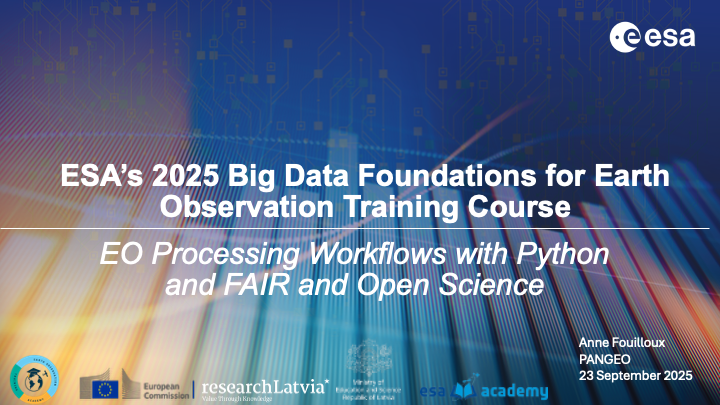
Welcome to the course materials for understanding modern Earth Observation processing workflows and implementing FAIR (Findable, Accessible, Interoperable, Reusable) data principles in professional environments.

QR-Code of the EO Processing Workflows & FAIR Data course material
Course Overview
This course bridges the gap between technical EO processing capabilities and strategic data management approaches, designed specifically for lecturers, industry professionals, and government representatives who need to understand and implement modern EO workflows in their organizations.
What Makes This Course Different
Rather than focusing purely on technical details, we emphasize:
- Practical applications showing how cloud-native EO processing solves real workflow challenges
- FAIR principles awareness applied specifically to Earth Observation contexts
- Operational examples from ESA’s platforms (EOPF, EarthCODE) demonstrating working implementations
- Hands-on exploration of modern tools and workflows you can continue using
Session Structure
Tuesday 09:10-10:30 (80 minutes)
Technical foundation demonstrating cloud-native EO processing, Python ecosystem, and operational workflows through live demonstrations of ESA services.
Tuesday 11:00-12:00 (60 minutes)
FAIR principles awareness applied to Earth Observation, with operational examples, readiness discussion, and introduction to implementation approaches.
Key Learning Outcomes
By completing this course, you will:
- Understand cloud-native EO processing and how it creates organizational value through improved efficiency and collaboration
- Experience modern Python tools and platforms through hands-on demonstrations relevant to your sector
- Assess your organization’s current data management practices and identify improvement opportunities
- Design practical implementation strategies with realistic timelines and resource requirements
- Recognize how FAIR data principles can improve data utilization in your organizational context
- Evaluate technical solutions and platforms based on your specific operational needs
- Connect with expert communities and ongoing support resources for continued implementation
- Build professional relationships with peers facing similar data management challenges
Interactive Learning Approach
This course combines multiple learning approaches:
- Live Demonstrations: Real-world exploration of ESA’s EOPF Sample Service and EarthCODE platforms with hands-on Python examples
- Interactive Discussions: Group reflection on FAIR principles applied to Earth Observation contexts
- Practical Examples: Concrete EO workflow scenarios demonstrating cloud-native processing benefits
- Resource Connections: Introduction to ongoing professional communities and platforms for continued learning
ESA Context
This course showcases ESA’s comprehensive approach to modern EO processing and FAIR data implementation through operational examples:
- Cubes & Clouds: Educational excellence in cloud-native EO processing Zellner (2025)
- EOPF Sample Service: Next-generation processing framework with Zarr optimization EOPF-Sample-Service (2024)
- EarthCODE: Comprehensive FAIR implementation across the EO ecosystem ESA (2025)
- Copernicus Data Space: Operational cloud platform for EO data access and processing European Space Agency (2024)
Prerequisites
Essential:
- General understanding of Earth Observation concepts and applications
- Familiarity with organizational data management challenges
- Interest in modernizing EO processing and data sharing approaches
Helpful but not required:
- Basic Python programming experience
- Knowledge of cloud computing concepts
- Experience with data management or open science initiatives
Technical Requirements
To fully engage with the interactive elements:
- Modern web browser with JavaScript enabled
- Stable internet connection for cloud platform exploration
- Optional: Python environment for local notebook execution (see requirements.txt)
Support and Community
During the Course:
- Real-time Q&A through shared Document (link to be provided by the instructor at the beginning of the course)
- Peer collaboration through group exercises
After the Course:
- Continued access to all course materials and updates
- EarthCODE Community support to publish datasets and workflows EarthCODE Discourse Forum
- EOPF Community support to learn more about EOPF Zarr data format EOPF Discourse
- Worldwide network via Pangeo Community Pangeo Community (2024) and ESA initiatives
- ESA’s Earth Observation Directorate for operational service examples
- Pangeo community Pangeo Community (2024) for cloud-native processing tools and practices
- FAIR data initiative leaders Wilkinson et al. (2016) for strategic frameworks
- International Earth observation community for standards and best practices
License and Reuse
These course materials are made available under Creative Commons Attribution 4.0 (CC-BY) license, following the FAIR principles Wilkinson et al. (2016) demonstrated throughout the course. You are encouraged to:
- Reuse and adapt materials for your educational or organizational needs
- Share improvements and extensions with the community
- Cite appropriately when building upon this content
- Contribute feedback and suggestions for continuous improvement
Bibliography
Acknowledgments
This course builds upon the collaborative efforts of the broader EO and open science communities, with special recognition to:
- Zellner. (2025). Cubes & Clouds - Cloud Native Open Data Sciences for Earth Observation. Zenodo. 10.5281/zenodo.15389591
- EOPF-Sample-Service. (2024). EOPF Sample Service: Collection of Python notebooks demonstrating the usage of the EOPF-CPM library. https://github.com/EOPF-Sample-Service/eopf-sample-notebooks
- ESA. (2025). EarthCODE: Earth Science Collaborative Open Development Environment. European Space Agency. https://earthcode.esa.int
- European Space Agency. (2024). Copernicus Data Space Ecosystem. https://dataspace.copernicus.eu/
- Pangeo Community. (2024). Pangeo: A community platform for Big Data geoscience. https://pangeo.io/
- Wilkinson, M. D., Dumontier, M., Aalbersberg, Ij. J., Appleton, G., Axton, M., Baak, A., Blomberg, N., Boiten, J.-W., da Silva Santos, L. B., Bourne, P. E., & others. (2016). The FAIR Guiding Principles for scientific data management and stewardship. Scientific Data, 3(1), 1–9. 10.1038/sdata.2016.18